

The fashion sector has increasingly sought to develop its production chain to be more sustainable and economically circular, based on ESG (Environmental, social, and corporate governance). But we know it is not easy, though necessary!
It is known worldwide that the fashion sector is not at all friendly to the environment, in addition to the scandals involving manufacturers that use child labor or labor analogous to slavery. The most recent data on environmental impact indicate that the fashion industry is responsible for discarding 20% of the world’s wastewater (water discarded after use in human activity), according to the United Nations Environment Programme (UNEP).
The closer attention consumers pay to these sustainability issues has put pressure on brands and companies, along with government laws that have also contributed to this movement of change.
Environmental, social, and governance (ESG) issues have become a fundamental item on the agenda of boards of directors and M&A transactions.
In a recent survey conducted by Bain & Company with 281 mergers and acquisitions executives, 65% expect their own company’s focus on ESG to increase over the next three years. This view extends to M&A: more than half of respondents see ESG leadership as an element for better asset valuation or expect this to be the case in the future, confirming the topic’s relevance in this context.
How did ESG emerge in the M&A world?
ESG emerged in the financial market as a way to measure the impact that sustainability actions have on companies’ results. The acronym first appeared in 2004, within a working group of the Principles for Responsible Investment (PRI), a UN-linked network that aims to encourage investors to adopt sustainable investing.
James Gifford, the economist who led the PRI, summarized the meaning of ESG:
“ESG is just a subgroup within the larger context of sustainable investment. If you have a responsibility, you should not be thinking on a 9-month horizon, but rather a 9-year, or 20-year one. And when you consider that horizon, topics such as climate change, sociopolitical risks, etc., become relevant. It is no longer about ethics.”

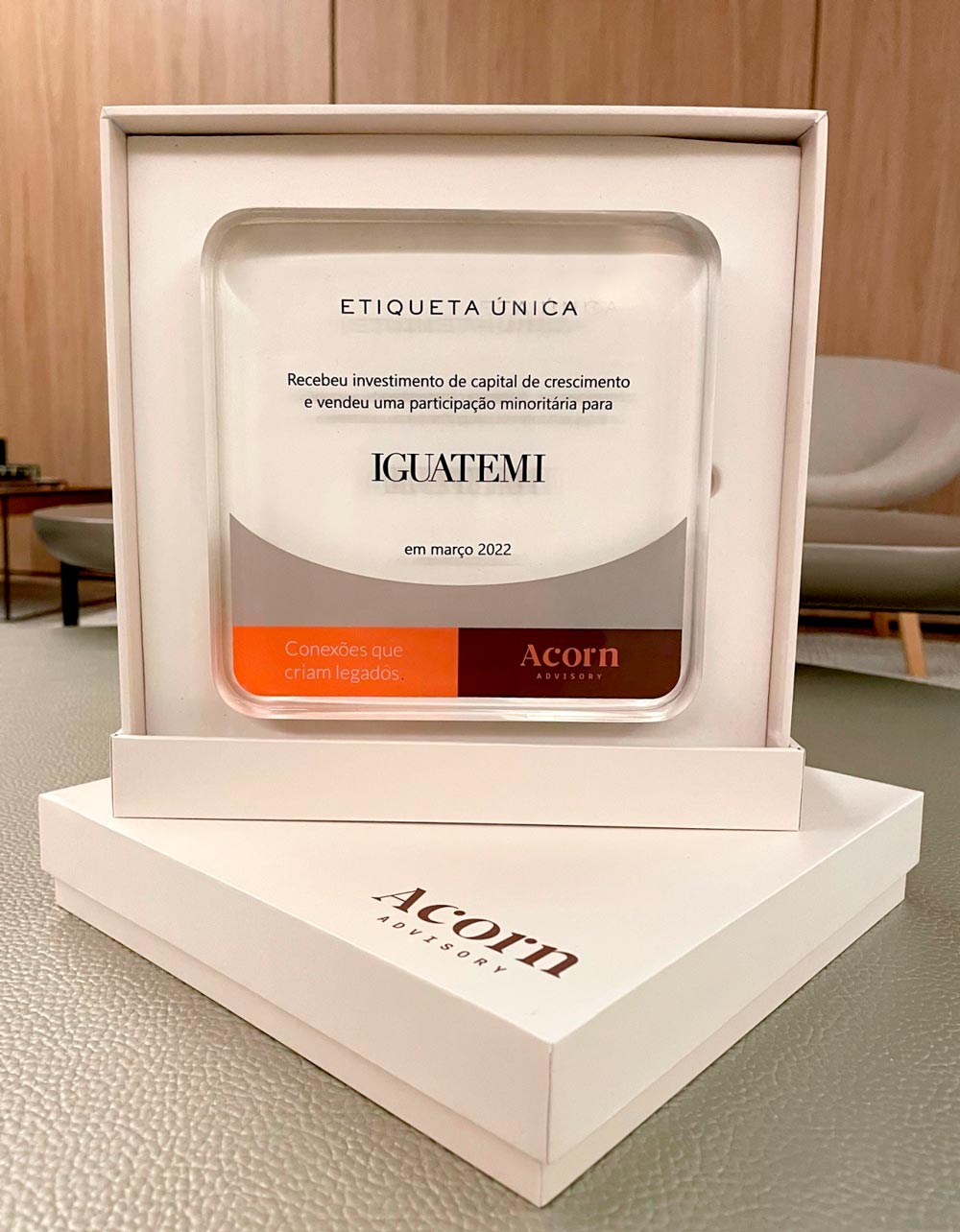
Case Acorn Advisory | ETIQUETA ÚNICA + IGUATEMI
Recently, Acorn acted as exclusive financial advisor to the shareholders of Etiqueta Única in the sale of a 23% stake to Iguatemi, one of the largest companies in the country’s shopping mall and real estate sector. The two brands joined forces to promote Collaborative and Sustainable Fashion with the goal of extending the lifespan of luxury products, conscious consumption, and the circular economy.
With the acquisition, Iguatemi enters a niche that is rapidly expanding and that seeks to promote more conscious consumption.
We still have a long way to go, but the question that remains is: how do you see the future of fashion in the sustainable and social universe?
#ESG #consciousconsumption #environmental #fashion #circulareconomy
Source: Estadão / Harvard Law School Forum on Corporate Governance / Bain & Company / Fusões&Aquisições.com